
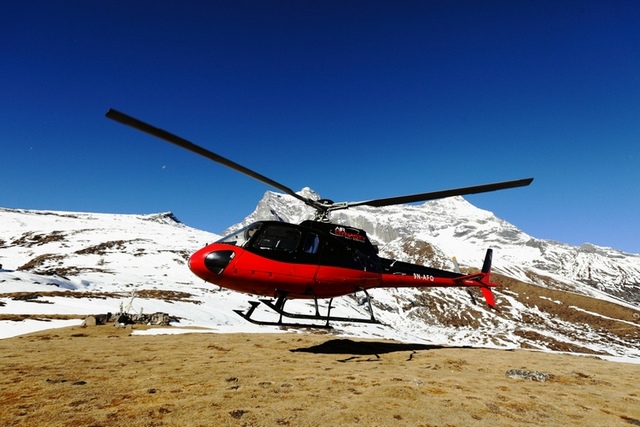
Most articles about timing a Himalayan helicopter tour really mean “timing an Everest tour,” and then just assume the answer’s the same everywhere else. It mostly is, but not entirely – and if you’re choosing between Everest, Annapurna, Mustang, or one of the lake routes, the differences are worth knowing before you lock in dates. This guide covers the Himalayas broadly. If you’ve already got your heart set on Everest specifically and want the deeper version of that story, we’ve written a dedicated piece on Everest Base Camp timing that goes further into that one route.
Here, let’s zoom out.
Table of Contents
The short version
Spring (March–May) and autumn (September–November) are the two seasons every serious operator in Nepal will steer you toward, across essentially every route we fly. Winter (December–February) is workable with the right expectations. Monsoon (June–August) is the one season where we’ll tell you plainly: go in with your eyes open, because the odds aren’t in your favor.
That’s true everywhere in the Himalayas. What changes route to route is how much each season matters, and that’s really the more useful question.
Why altitude changes the calculation more than people expect
Here’s something that doesn’t get said enough: a helicopter tour to Muktinath or Pokhara-area lakes and a tour to Kala Patthar near Everest are not equally sensitive to weather, because they’re not flying to the same altitude. Everest-region flights push toward 5,500 meters. Annapurna Base Camp sits lower, around 4,000 meters. Muktinath and the Mustang routes lower still. The higher you go, the thinner the air, the harder the helicopter has to work, and the less margin there is if a cloud bank rolls in or the wind shifts.
Practically, this means the Everest route is the most weather-sensitive tour we operate — which is exactly why it’s the one most worth booking in spring or autumn specifically, and why we’re more cautious about winter and monsoon bookings for that route than for some of the lower-altitude ones.
Route by route
Everest region (Everest Base Camp, Kala Patthar, Gokyo Lake): The least forgiving of poor weather, given the altitude. Spring and autumn aren’t just preferable here, they’re close to essential if you want a reliable flight rather than a coin toss. Winter can work on a clear day but expect more forecast-checking and flexibility required. Monsoon is genuinely risky on this route specifically — this is the one where we’d most strongly discourage betting your whole trip on a single scheduled date.
Annapurna Base Camp and Mardi Himal: Lower altitude than Everest, so slightly more forgiving, but still very much a spring/autumn-favored route. Afternoon cloud buildup in the Annapurna region during monsoon is a known pattern, so morning departures matter here just as much as anywhere.
Muktinath and Upper Mustang: Mustang sits in a rain shadow — it gets noticeably less monsoon rainfall than the rest of Nepal, which actually makes this one of the more monsoon-tolerant routes we offer. If you’re traveling in July or August and don’t want to give up on a helicopter tour entirely, Mustang is worth a specific look.
Rara Lake, Gosainkunda, and the western lake routes: Beautiful in nearly every season for different reasons — Gosainkunda has genuine religious significance tied to specific pilgrimage timings, so some travelers deliberately choose their season around that rather than pure weather optimization. Worth telling us your priority (best weather vs. best timing for the pilgrimage) when you book.
A note on winter that most guides skip
Winter doesn’t get talked about much, and when it does, it’s usually dismissed in a sentence. That undersells it. A clear winter morning over the Himalayas is genuinely one of the best-looking flights we run all year — the snow cover is total, the air is often perfectly still, and there’s a stark, quiet beauty to it that spring’s rhododendrons and autumn’s golden light don’t really replicate. The tradeoff is consistency, not quality: winter days are more hit-or-miss than spring or autumn, so you need to hold your schedule a little looser and be ready to shift a day if the forecast calls for it.
What we’d actually tell you if you called us
If you asked us directly which two weeks to pick with zero other constraints, we’d say late April or mid-October — right in the heart of spring and autumn, past the very beginning and end of those windows where weather still has some monsoon or winter carryover. If you’re locked into a monsoon-season trip because that’s when you have vacation time, we’d steer you toward Mustang over Everest, and toward morning flights without exception. If you’re chasing a specific visual — snow, wildflowers, golden autumn light — that preference might matter more to you than squeezing out the last percentage point of reliability, and that’s a completely reasonable way to choose.
Not sure which season fits your travel dates? 📍 Kathmandu, Nepal 📞 Tell us your dates and we’ll give you a straight answer on the odds, not just a sales pitch ✉️ WhatsApp, call, or email — happy to help you time it right
👉 Browse our full range of helicopter tours 👉 Everest Base Camp timing, in more depth
Weather patterns shift year to year and no season guarantees a clear day. We track conditions closely and will always tell you honestly what your odds look like before you book.