Booking an Everest helicopter tour is usually the easy part. Knowing what actually keeps you safe up there — the regulations, the weather calls, the altitude physiology, the insurance fine print — is what most people never think to ask about until they’re already at the airport in Kathmandu. So here’s the straight version, covering what actually matters before you strap in.
Table of Contents
Is an Everest Helicopter Tour Safe?
Short answer: yes, when it’s flown by a CAAN-licensed operator following Nepal’s civil aviation rules, and when the pilot is given the authority to say no on a bad-weather day. Helicopter tours to the Everest region operate under the Civil Aviation Authority of Nepal (CAAN), which issues Air Operator Certificates, licenses pilots and engineers, and enforces Nepal’s Civil Aviation Regulations in line with ICAO international standards. That’s the regulatory backbone. The rest — how seriously an operator treats maintenance, how much mountain-specific training its pilots have, how disciplined it is about turning back when the valley closes in — is where the real variation between operators shows up.
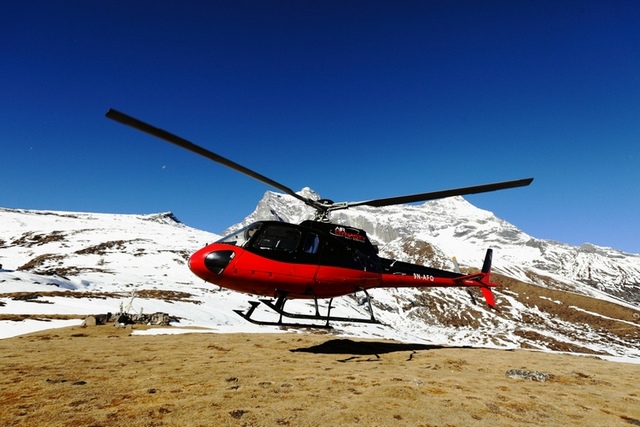
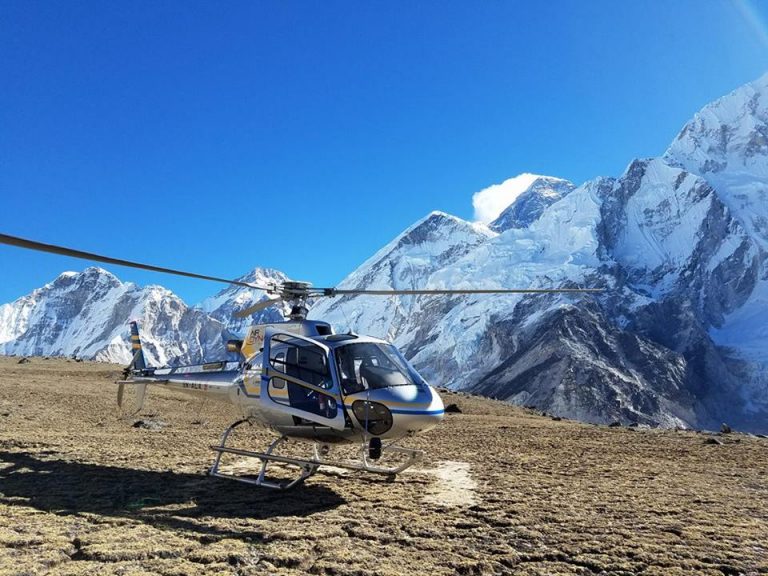
The tour itself is genuinely short. Most Everest helicopter flights leave Kathmandu (1,338 m) early in the morning, climb toward Kala Patthar (5,545 m) or the Everest Base Camp area, spend a brief window at altitude, and land back in the city inside a few hours. That brevity is actually one of the safety advantages over trekking the same route: less exposure time at altitude, and a pilot who can turn the aircraft around at the first sign of trouble instead of a trekker who’s already three days deep into the valley.
Who Actually Checks the Helicopters and Pilots
Every commercial helicopter flying in Nepal gets a pre-flight inspection before it leaves the ground, on top of scheduled maintenance every 50 flight hours, a more thorough check at 100 hours, and a full annual airworthiness review. Major components — main rotor gearboxes, turbine engines — get overhauled or replaced on intervals set anywhere from 300 to 2,500 flight hours depending on the part. Aircraft flying these routes also carry emergency locator transmitters, multi-point harnesses, fire extinguishers, first-aid kits, and increasingly, terrain awareness warning systems that alert the pilot if the aircraft gets too close to rock or ridge lines in poor visibility.
On the pilot side, commercial operators require a Commercial Pilot License or Airline Transport Pilot License, a current Class 1 medical certificate, and typically 150 to 200 logged flight hours before a pilot is cleared for mountain routes. Flying to Everest also calls for specific training beyond the standard license: density altitude calculations, canyon and ridge flying techniques, and rehearsed emergency escape routes for terrain that doesn’t forgive mistakes. This is worth asking about directly if you’re comparing operators — a pilot with genuine high-altitude hours behind them is a different proposition from one who’s simply licensed.
Weather Rules: Why Your Flight Might Get Delayed
This is the part that surprises first-time flyers the most. Nepali civil aviation requires at least 5,000 meters of ground visibility along the flight corridor, with clear separation from cloud, before a helicopter is cleared for mountain operations. That’s a hard line, not a guideline, and the pilot has final authority to delay or divert regardless of what’s written on your itinerary.
Flights are scheduled in the early morning — generally between 6 and 11 a.m. — because the air is cooler and calmer then. By midday, rising heat over the valleys creates thermal turbulence and cloud buildup that make the route far less predictable. If your flight can’t go, it’s normally pushed to the next available morning window, with a refund offered if that doesn’t fit your travel dates. It’s a reasonable trade: helicopters have more flexibility than fixed-wing aircraft, which can face ten-to-fifteen-day backlogs when a single-runway mountain airstrip closes, but they still answer to the same weather.
Crosswinds, low cloud, and fog over the valley are the usual culprits for a delay, not engine or mechanical issues. If your operator reschedules you, that’s the system working as intended, not a red flag.
Altitude Sickness on a One-Hour Flight – What Actually Happens
This question comes up constantly, and the physiology is worth understanding rather than guessing at. Acute mountain sickness typically sets in several hours after reaching altitude, often overnight after the first night at elevation — it’s a function of sustained exposure, not just elevation itself. A helicopter tour that spends ten to fifteen minutes on the ground at Kala Patthar, or thirty to forty-five minutes at a stop like Hotel Everest View (3,880 m), simply doesn’t give altitude sickness the runway it needs to develop in most healthy travelers.
That doesn’t mean you’ll feel nothing. At 5,545 meters, the air holds roughly half the oxygen you’re used to at sea level, and it’s common to notice breathlessness after minimal movement, a light head when you stand or turn quickly, a mild headache, a faster heartbeat, or feeling colder than the thermometer would suggest. These are short, manageable effects for most people rather than warning signs — but they’re also exactly why operators keep ground time brief and carry emergency medical oxygen on all flights above 3,000 meters as standard practice.
A few things genuinely help: sleep properly and skip alcohol the night before, stay hydrated, eat something light beforehand, move slowly when you step out at altitude, and dress warmly since temperatures at the landing point often sit well below freezing even on a clear day. If you have a history of heart disease, angina, a previous heart attack or stroke, a chronic lung condition, severe anemia, are pregnant, or have had recent surgery, talk to a doctor before booking — these are the conditions where even a brief stop at extreme altitude carries real risk, and it’s worth being upfront about it rather than hoping it won’t come up.
One more detail that matters for safety, though people rarely connect it to sickness prevention: density altitude above 4,000 meters reduces both rotor lift and engine performance, which is why operators cap passenger numbers per flight — often around five passengers up to 3,800 meters, dropping to about three above 4,300 meters. That’s not a service downgrade; it’s the same physics that limits how long anyone should linger at that elevation, built directly into how the flight is planned.
Do You Need Special Travel Insurance for a Helicopter Tour?
Yes, and this is the part people skip until it’s too late to fix. A scenic helicopter tour itself is a routine commercial flight, but the concern here is what happens if something goes wrong at altitude and you need medical evacuation — and standard travel insurance often doesn’t cover that the way people assume it does.
Two things to check before you fly. First, the altitude limit written into your policy: many standard policies only cover activity up to 3,000–4,000 meters, while the Everest region routinely puts you above 5,000 meters. Look for a policy that explicitly covers 5,500–6,000 meters or higher. Second, the coverage amount — $100,000 or more in medical coverage is the commonly recommended minimum for high-altitude regions in Nepal, since helicopter evacuation and treatment costs add up quickly.
If you do ever need an evacuation, the sequence matters: contact your insurer’s emergency assistance line before anyone arranges a helicopter, not after. Insurers generally only guarantee full coverage when they’ve authorized the evacuation in advance, partly because it lets them verify medical necessity and arrange payment directly with a reputable operator. Keep your policy number and emergency contact number saved somewhere you can reach without needing a hotel Wi-Fi password.
Best Time of Year for a Safer Flight
Spring (March–May) and autumn (September–December) are the two windows worth planning around. Skies tend to be clear and weather more predictable in both, which is why it’s genuinely rare for flights to be cancelled during autumn specifically. Winter (December–February) can offer some of the most striking snow-covered views and occasional windows of near-perfect flying weather, but fewer helicopters operate then due to lower demand, and postponements are still possible. Monsoon season (June–August) is the one to be flexible around — bad weather can develop anywhere along the route, in Kathmandu, or in the mountains themselves, though clear windows do still open up.
If your schedule allows it, building one or two spare days into your Kathmandu itinerary around a helicopter tour is the single most practical thing you can do to avoid a scramble if the first attempt gets weathered out.
A Practical Checklist Before You Fly
A few things worth confirming with whichever operator you book with, Nepal Helicopter Service included: that the aircraft and pilot are CAAN-licensed and currently within their maintenance cycle, that the flight departs in the early morning window rather than midday, that emergency oxygen is carried on board, and that your travel insurance covers both the altitude you’ll reach and helicopter evacuation specifically. Pack layers regardless of the season, mention any relevant medical history at booking rather than on the tarmac, and if you feel unusually unwell once you’re on the ground at altitude, say so immediately — pilots take that seriously and would rather cut a stop short than have a passenger push through discomfort.
Frequently Asked Questions
Is it safe to fly a helicopter to Everest Base Camp?
Yes, with a CAAN-licensed operator following standard maintenance and weather protocols. The main risks — weather and altitude exposure — are managed through strict visibility rules and short ground times rather than eliminated outright, which is normal for high-altitude aviation anywhere in the world.
What happens if my flight gets cancelled for weather?
It’s rescheduled to the next available morning slot, or refunded if that doesn’t work with your travel dates. This is standard practice, not a sign the operator is unreliable — Nepal’s mountain weather changes fast and pilots are required to stay well within visibility limits.
Can you get altitude sickness on a one-hour helicopter tour?
Full acute mountain sickness is unlikely given the short exposure time, but mild effects like breathlessness or light-headedness at the landing point are common and normal. People with heart or lung conditions should get medical advice before booking.
Does regular travel insurance cover helicopter evacuation in Nepal?
Not always. Check that your policy covers the specific altitude you’ll reach (5,500–6,000 meters for Everest region flights) and includes emergency helicopter evacuation with a coverage minimum of $100,000 or more.
What’s the best month to book for the safest flying conditions?
Autumn (September–December) has the most consistent clear weather, followed closely by spring (March–May). Both offer far fewer weather-related cancellations than monsoon season.
What safety equipment do Everest helicopter tours carry?
Standard equipment includes multi-point harnesses, fire extinguishers, first-aid kits, emergency locator transmitters, and medical oxygen cylinders on all flights above 3,000 meters.
Before You Book
None of this is meant to talk you out of the flight — it’s meant to help you ask the right questions before you’re standing at the helipad. A well-run Everest helicopter tour, flown by a licensed pilot in a properly maintained aircraft, with weather protocols respected and your insurance sorted in advance, is one of the more controlled ways to see the world’s highest mountains up close. At Nepal Helicopter Service, every flight runs on exactly these CAAN standards — licensed pilots, maintained aircraft, and a strict weather-first policy on every departure. If you’re planning a trip and want to talk through timing, routes, or what to check on your insurance before you fly, reach out and we’ll walk you through it.