Nepal Helicopter Service | Kathmandu, Nepal
One of the first things that surprises our guests happens at the airport. Before anyone boards, every passenger steps on a scale, bag and all. Nobody is judging. In the Himalayas, weight is one of the things that decides whether a helicopter can fly safely at all.
This guide explains why weight matters so much in Nepal, what the limits look like in practice, and how to plan so your group isn’t caught out on the morning of the flight.
Table of Contents
Why weight matters more in the mountains
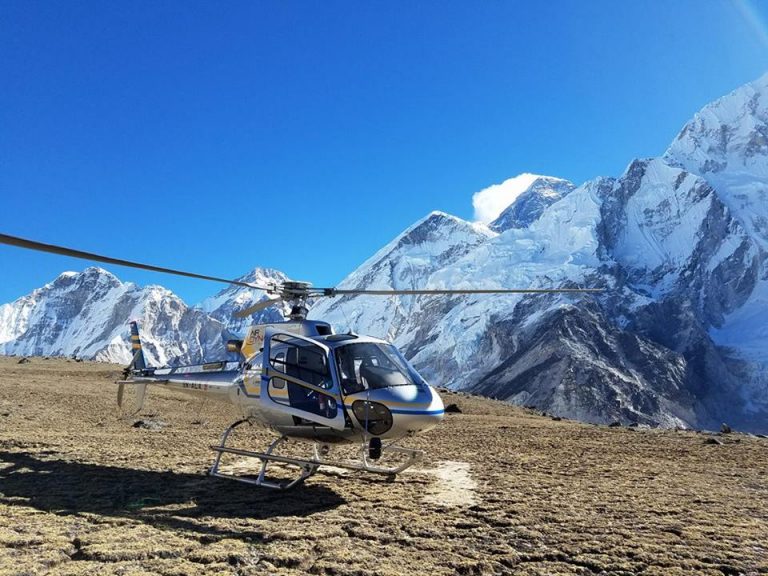
A helicopter’s rotor pushes air down to create lift. The thinner the air, the less lift it can make. At Kathmandu (1,338 metres) the air is thick enough for a full load. At Everest’s Kala Patthar (5,545 metres) there is roughly half as much air, and the same helicopter can lift far less.
Temperature matters too. Warm air is thinner than cold air, which is one reason mountain flights leave early in the morning. Before every flight the pilot works out how much fuel, how many passengers and how much luggage the helicopter can carry for that route and that day’s conditions. In Nepal, the pilot has the final say, and a responsible operator will never overrule them.
The helicopters doing the work
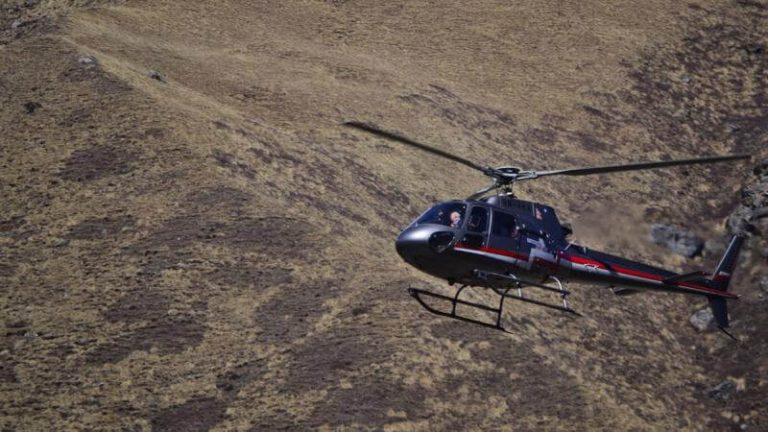
Most tourist and rescue flights in the high Himalaya use the Airbus AS350 B3e, also known as the H125. It holds records for high-altitude landings and is the standard aircraft for places like Everest Base Camp. At lower altitudes it carries a pilot and up to five passengers.
What the limits look like in practice
Every flight is different, but these rough figures are a useful guide:
| Where you are flying | Typical passengers per helicopter |
|---|---|
| Kathmandu, Pokhara and lower hills | Up to 5, with a combined passenger weight of roughly 450–500 kg |
| Lukla and Hotel Everest View (about 2,800–3,900 m) | Usually 4–5, depending on weight and temperature |
| Kala Patthar, Everest Base Camp area (above 5,000 m) | Often only 2 |
That last line is why our Everest Base Camp helicopter tour lists the Kala Patthar landing options as two passengers. On shared tours with more people, the helicopter often drops part of the group at a lower point, flies the first pair up, then comes back for the rest.
Is there a limit per person?
There is no single legal number, but most operators plan around an average of about 80 to 100 kg per passenger. If you weigh more than about 100 kg, tell us when you book. It doesn’t mean you can’t fly. It may mean fewer people share your helicopter, or that we suggest a private charter so the load works for the route.
Please don’t guess low. Everyone is weighed at the airport anyway, and discovering a problem at 6am is far more stressful than sorting it out by email a week earlier.
Luggage
- Sightseeing tours (Everest, Annapurna, Muktinath): bring a small day bag with a warm layer, water and your camera. Leave suitcases at the hotel.
- Lukla flights for trekkers: baggage is limited and counts towards the helicopter’s total load. Confirm your allowance before you pack, and expect to pay for excess weight or send extra bags separately.
- Charters with cargo: helicopters can carry supplies instead of passengers, within the same weight limit. Tell us exactly what you are sending.
Camera gear counts. A full photography kit with lenses and a tripod can weigh as much as a small child. And please don’t plan to fly a drone from the landing site without the permits Nepal requires.
How weight affects the price
Shared seats are priced per person because the helicopter is filled with several passengers. Private charters are priced per helicopter. If your group is heavy for a high-altitude route and needs two helicopters, or an extra shuttle, the cost goes up. Giving us accurate weights early lets us quote the right price the first time.
Tips for a smooth flight
- Share honest weights for everyone when booking.
- Wear your warm layers instead of packing them.
- Keep one small bag per person.
- Tell us about heavy camera or medical equipment in advance.
- Stay flexible about who flies up first on shared high-altitude landings.
Quick answers
Is there a weight limit for helicopter tours in Nepal?
Yes. There is a total limit for each flight, based on altitude, temperature and fuel. Most operators plan around 80 to 100 kg per passenger, and heavier passengers should tell the operator when booking.
Why can only two people land at Kala Patthar?
At 5,545 metres the air is so thin that a helicopter can lift far less weight, so it usually carries only two passengers plus the pilot for the landing.
How much luggage can I take on a helicopter tour?
For sightseeing tours, just a small day bag. Trekkers flying to or from Lukla have a limited allowance that should be confirmed before packing.
Not sure how your group fits? Send us the number of passengers, rough weights and your route, and we will tell you exactly how the flight would work. WhatsApp +977 9818392976.
Figures in this article are general planning guidance. The pilot decides the actual load for every flight based on the day’s conditions.